
Tooth Pain That Gets Worse When You Lie Down: What It Is Telling You

Quick Answer
Tooth pain that gets worse when you lie down usually means the nerve inside the tooth (the pulp) is inflamed. Lying flat increases blood flow and pressure inside a sealed pulp chamber that has no room to swell, so the throbbing intensifies within minutes of your head hitting the pillow. In most cases this pattern points to irreversible pulpitis or an early abscess, and it is a signal the tooth needs treatment rather than another night of waiting.
Key Takeaways
- Pain that spikes when you lie down is a pressure problem, not a coincidence or a sign you are imagining it.
- The most common cause is irreversible pulpitis — nerve inflammation that will not settle on its own.
- Sleeping propped up on two or three pillows and using cold, never heat, is the most reliable overnight measure.
- If the pain suddenly stops completely, that is usually nerve death, not recovery — and infection is still spreading.
- Facial swelling, fever, or trouble swallowing changes this from urgent to emergency. Call immediately.
- Urgent Dental Care of Houston takes walk-ins Friday, Saturday, and Sunday, 8 AM to 8 PM, from Jersey Village, Spring Branch, Cypress, and across Northwest Houston. Call 346-641-0606.
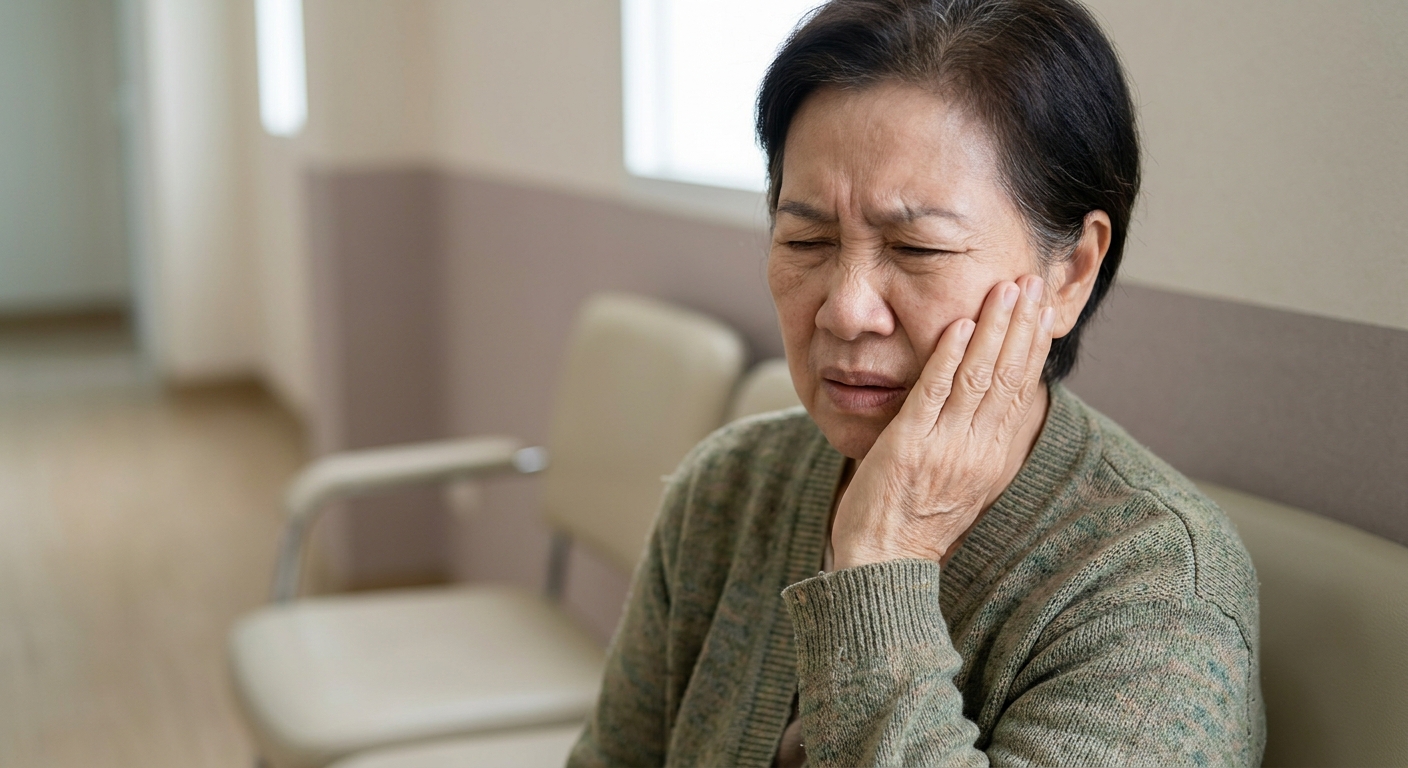
Why does tooth pain get worse when I lie down?
Lying flat redistributes blood toward your head and increases pressure inside the tooth. The pulp — the nerve and blood vessel bundle at the center of the tooth — sits inside a rigid chamber of dentin and enamel that cannot expand. When that tissue is already inflamed and swollen, even a small increase in pressure has nowhere to go, so it presses directly on the nerve.
Three things stack up at once at night:
- Postural blood flow. Horizontal position raises intrapulpal pressure measurably within minutes.
- Fewer distractions. Daytime noise, work, and movement mask a pain your brain cannot ignore in a dark, quiet room.
- Lower natural anti-inflammatories. Cortisol drops overnight, so your body's own inflammatory brake eases off.
"Patients often apologize for calling about pain that seemed fine at 3 p.m.," says Dr. Tarsem Lal, DDS. "But the pattern itself is diagnostic. When someone tells me the tooth is bearable all day and unbearable the moment they lie down, I already have a strong idea of what the X-ray will show."
Our Friday morning walk-in list is full of people from across Northwest Houston who have been awake most of the week and finally decided the pain was not going to sort itself out.
What does it mean if my tooth only hurts at night?
Night-only tooth pain almost always means the pulp is involved rather than the gum or the enamel surface. Surface sensitivity is triggered by something — a cold drink, sugar, a blast of air conditioning — and stops within seconds. Pulpal pain is triggered by position and lingers.
Pain pattern comparison
If your row is in bold, the tooth will not settle without treatment. Walk-in emergency dental care is available at our Westway Park Boulevard office, just off Beltway 8.
Is throbbing tooth pain at night an emergency?
Throbbing night pain alone is urgent, not life-threatening — but it becomes a true emergency the moment swelling or systemic symptoms appear. The dividing line is whether the infection has stayed inside the tooth or escaped into surrounding tissue.
Go to an emergency room, not a dental office, if you have:
- Difficulty breathing or swallowing
- Swelling under the tongue or spreading down the neck
- Inability to open your mouth more than a finger's width
- Fever above 101°F with confusion or rapid heartbeat
- Swelling closing one eye
Northwest Houston has hospital emergency departments along US-290 and I-10 for these situations, including HCA Houston Healthcare Northwest and Memorial Hermann Memorial City. For everything short of that list, a dentist is the faster and far cheaper route, because an ER can medicate the pain but cannot treat the tooth.
How can I stop tooth pain at night so I can sleep?
You can reduce the pressure that is causing the throb, though you cannot fix the underlying problem at home. Elevation and cold are the two measures that consistently work; heat and alcohol reliably make things worse.
What helps vs. what backfires
Confirm dosing with your pharmacist, particularly if you take blood thinners, blood pressure medication, or have kidney or stomach conditions. Escalating your own dose across several nights is itself a reason to be seen.
What happens if I keep waiting? A realistic timeline
Untreated pulpal pain follows a predictable arc. Knowing where you are on it tells you how much room you have.
The dangerous moment is Stage 3, because it feels like recovery. Every stage after it costs more, takes longer, and narrows your options.
Can it wait? A decision matrix
Anything in the right-hand column should not be left over a weekend. That is precisely the gap we exist to fill — we run walk-in emergency hours Friday through Sunday, 8 AM to 8 PM, when most Northwest Houston practices are closed.
Myth vs. Fact
What will an emergency dentist actually do?
The visit is shorter and more straightforward than most people expect. The goal is to identify the tooth, relieve the pressure, and get you sleeping tonight.
- Focused exam and digital X-ray — usually 10 minutes
- Vitality and percussion testing to confirm which tooth is responsible
- Diagnosis and written estimate explained before anything begins
- Treatment the same visit — most often opening the tooth to release pressure and beginning emergency root canal treatment, or extraction if the tooth cannot be saved
Our $89 emergency exam includes the comprehensive exam and digital X-rays, so you leave with a diagnosis and a written plan even if you decide to think it over. In-house financing is available for treatment that goes beyond what you planned to spend that day.
About the author
Dr. Lal, DDS practices at Urgent Dental Care of Houston, 4410 Westway Park Blvd #600, Houston, TX 77041, a walk-in emergency dental practice serving Northwest Houston including Jersey Village, Spring Branch, Cypress, Copperfield, Bear Creek, Willowbrook, the Energy Corridor, Memorial, and Katy. Dr. Lal has spent years diagnosing pulpal pain from the pattern patients describe on the phone, and runs a walk-in emergency schedule built around the Friday-to-Sunday window when weekday practices are shut.
This article is for general education and does not replace an in-person examination.
Frequently Asked Questions
Why does my tooth throb only at night in Houston's humidity? Humidity itself does not cause pulpal pain — position does. Gulf Coast allergy seasons can add sinus pressure on upper molars, which sometimes gets blamed for a genuinely separate dental problem.
How long can irreversible pulpitis last before something changes? Usually two to ten days before the nerve dies and the pain stops. That silence is not improvement, and infection typically reaches the bone within another one to two weeks.
Can I sleep sitting up to avoid the pain? Yes, and it genuinely helps. A recliner or two to three firm pillows keeps your head above heart level and reduces pulpal pressure enough for many people to sleep.
Does ibuprofen or acetaminophen work better for night tooth pain? Anti-inflammatories generally outperform acetaminophen for pulpal pain because inflammation is the mechanism. Follow the label, and ask your pharmacist before combining anything.
Why does hot food make it worse but cold gives relief? That reversal is a hallmark of a dying or necrotic pulp. Heat expands gases inside the chamber and cold contracts them, which is why some patients sleep with ice water.
Is this a cavity or an abscess? A deep cavity causes lingering pain without swelling; an abscess adds a gum bump, bad taste, pain on biting, or facial swelling. Only an X-ray reliably separates them.
Can a cracked tooth cause pain that is worse lying down? Yes, once the crack reaches the pulp. Cracks are notoriously hard to see on X-rays, so diagnosis often relies on bite testing.
Will a night guard help if I grind my teeth? A night guard prevents future damage but will not touch existing pulpal inflammation. If grinding cracked a tooth, the crack still needs repair.
I'm pregnant — can I be treated? Yes. Untreated dental infection carries more risk than treatment, and the second trimester is generally the most comfortable window. Tell us at booking so we can adapt imaging and anesthetic.
What if the pain is on the upper teeth and I also have congestion? Sinus pressure typically affects several upper teeth at once and worsens when you bend forward. Pain isolated to one tooth that lingers after hot or cold is dental until proven otherwise.
Can you treat me on a Saturday or Sunday? Yes — that is when we are open. Walk-in hours run Friday, Saturday, and Sunday from 8 AM to 8 PM, covering the weekend gap left by weekday-only practices across Jersey Village, Spring Branch, and Cypress.
What if I don't have insurance? The $89 emergency exam includes X-rays and a written estimate with no obligation, and in-house financing is available so cost does not delay treatment.